Showing posts with label dance jewellery. Show all posts

Tuesday, January 15, 2019

Temple Jewelry - How do Artisans make it?


Temple Jewelry Making 

Temple jewelry has been a part of south Indian tradition for centuries now. Ancient Tamil literature and its historical writings list many types of jewelry worn by idols, gods and goddesses. The art of jewelry making is known to have originated somewhere in the reign of Chola dynasty in the 9th century, and it was a celebrated form of art all the way through Pandya Dynasty and the Krishnadevaraya rule from the 9th century till the 16th century. This traditional jewelry or temple jewelry is made by using silver or gold as a base engraved and crafted to intricate designs with some precious stones embedded on them. The embedded stones may be dark green or dark reddish maroon in color.

Temple jewellery, an essential part of the adornment of the Tamil bride, is also an integral part of the aharya or costume of a Bharatanatyam or Kuchipudi dancer. Bharatanatyam is one of the classical dances in India which has its origin from religious rituals. Bharatanatyam is one of the oldest and most popular forms of classical in South India. Temple jewelry is important in the form of accessories to the costumes used in Bharatnatyam and Kuchipudi. The bharatnatyam dance jewelry sets are made with dark green & dark maroon –red, quality called kempu stones, also known as temple jewelry. The traditional temple kempu jewelry are the designs worn by Maharanis or Devadasis in the ancient times. Now days they have become fashionable to be worn for wedding, occasions and Indian dance forms like Bharatanatyam , and Kuchupudi. The stones are un-cut polished stones in red & green. Besides being a part of dance costumes and bridal adornment, the deities and idols are also heavily decorated with jewelry.
The temple jewelry is made precisely by hands of traditionally trained artisans. Vadaserry, a tiny village on the outskirts of Nagarcoil is famous of the crafting of traditional temple jewelry. About 60 jewelry making units are working with each of them having about 350 artisans, trained in a traditional way.
Dance Jewelry
Jewelry from www.JewelsAmore.com
The main steps involved in the making of the temple jewelry are:
·         A die of the required shape is made. It contains the engraving and minor detailing work that needs to be in the jewelry. These shapes and details may resemble the figures of deities, parrot, serpent, lotus, motifs, faces of gods and goddesses or any other of the sacred symbols.
·         A gold foil is mechanically worked on the die to give it the shape of the die, working takes place in cold conditions, and no excessive heating of the gold is required. Moreover a sheet of gold is used with relevant thickness.

·         After it has been shaped, the jewelry piece is embedded and embossed with the precious stones ‘kuchu kal’, the precious red or green stones.
·         Final step is giving it a nice surface finish, polishing and an antique finish.
There is a piece of jewelry all the way down from head to toe. Gold is auspicious and considered to be a symbol of health and prosperity. Jewelry pieces are made for forehead, nose, neck, abdomen (belly), upper arm, fore arm, wrist, finger of hands and feet, for ankles, waist, earlobes, etc, covering almost every part visible. Moreover different combinations of jewelry pieces can wear on different occasions, for instance ornaments used by a bharatnatyam dancer are as follows:
1.      Long Necklace
2.      Short Necklace
3.      Hip Chain (Waist Belt)
4.      Head Set (with the sun and moon)
5.       Earring set
6.      Hair to Earring Chain
7.      Hair Clip
8.       Nose Studs
9.       Bangles

As the time has passed by the affordability and accessibility of temple jewelry has changed, the design of jewelry itself has evolved and modified.  These days, silver metal is used as the base for the piece and is later plated with gold. The recreation of the antique gold jewelry has made it affordable for anyone who wants to feel like a part of traditions and cultures. The artisans of Vadaserry also export these pieces of ancient Indian heritage to America, Canada, London, Singapore and Malaysia. The crafting of the temple jewelry is more than just a way for employment and professionalism but also a way for the preservation of the art form for the next generations.


Thursday, February 2, 2017

Alta, the red color dye in Indian Classical Dance

ALTA, THE RED COLOR DYE FOR INDIAN CLASSICAL DANCER

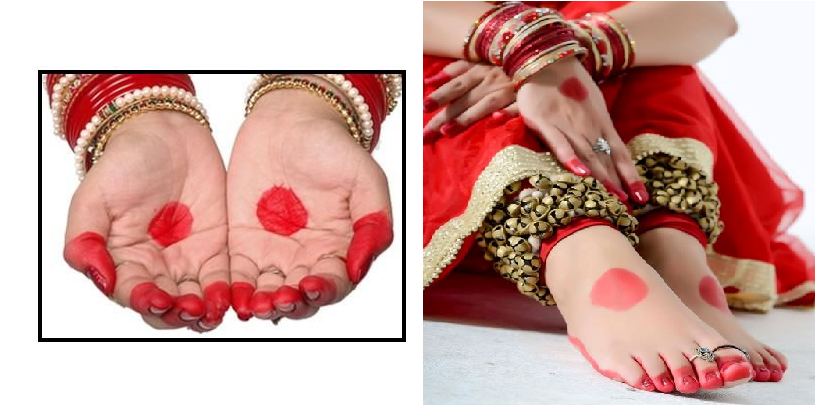
Alta is the bright red color liquid ink applied on the fingers and feet of an Indian Classical dancer. 

Most of the Indian classical dance forms have many meaningful mudras which are symbolic hand gestures used by the dancer to explain and express. 

Please see below some pictures where Altha is used in hand and feet of an Indian dancer.
 

Painting the hands and feet with Alta brings out the beauty of and expressiveness. It is a common practice to paint traditional designs on to hand and feet during festivals, Indian weddings and Hindu poojas.

Alta in olden days was made from betel leaves. It was replaced with artificial products like Sindoor and Kumkum to create similar liquid. In today’s time, the mostly available Alta is made out of chemical colors and is banned in some countries as it can cause severe allergies. Modern dancer use high quality red markers, which are convenient to carry and use. These are safe permanent markers of specific brands and easily washable after the program or ceremony.

Thursday, February 5, 2015

Bharatanatyam - Lord Shiva's Dance

Bharatanatyam finds its origins interlocked with classical Indian dance that mimics one of the basic five elements of life. Which when performed is a hypnotizing dance that resembles a flame, to honor Lord Shiva-supreme lord of dance. Traditional dance jewelry worn during the Bharatanatyam dance is known as temple jewelry, which was originally made from gold with rubies, emeralds and pearls. Used by the Devadasi girls as they danced in the temples to honor Lord Shiva original dance.

Artisans created theses authentic masterpieces for centuries in the southern part of India. Even today people revere and covet temple jewelry for its unique beauty and craftsmanship.  Bharatanatyam temple jewelry, combine with the silk multi-functional costume, which becomes enhanced with bells that allow each foot gesture to have a voice. Which seduces and captivates the audience in a mystic trance, As the performer goes through the motions of the dance the costume flows with them. Stimulating the audiences eyes with broad colors, while using body language and hand gestures to portray the ritual dance.

Originally, temple jewelry beautified the gods and goddesses in the temples during the 9th century. Later, women of the South India adopted a liking for the jewelry, which terpsichorean use in their routine to pay respect to their heritage.

There are 10 jewelry pieces that make up the set to do a Bharatanatyam dance: Choker, Long Chain, Mattal, Nath, Bullakku, Ottiyanam, Jimikki, Bangels, Rakkodi, Chandran/Sooryan and Nethichutty. A beginner can get by with a head set, necklace, and belts.  Every piece of the Bharatanatyam performer is essential to the routine even the performers hair dressed with a Chandra (moon shaped) and Surya (sun shaped) ornaments.

The Saree skirt style or Pyjama style which have gold Zari embroidery designs on the skirt. Open when the dancer performs a special posture known as a arai mandi (half-sitting) and muzhu mandi (full sitting). Ever aspect of the beautiful performance ties together giving the audience a breathtaking display meant for a king or god.

Wednesday, September 9, 2009

Temple Jewellery

Temple Jewelry belongs to the tradition of India. Olden days, Temple Jewelry was worn by only Devadasi girls who perform dance in temple and in Darbars. Now a days, it is not uncommon to see south Indian brides wearing Temple Jewellery for their weddings. So today, one can say the Temple Jewellery is traditional South Indian jewellery. The origin of Temple Jewellery dates back to 12th century. This was the period of famous Dravidian Tamil Dynasty known as “Chozha kulam” who ruled southern part of India. All the Chozha kings gave very importance to cultural development and most of the of the temple jewelry today are similar to the designs in the heavily ornamented pillars with accurate details and rich sculpted walls of many south Indian Temples, especially ones in Thanjavur.Today temple jewelry is prepared in a variety of metals. Originally it was made of gold with ruby, emerald & pearls and was used by the devadasi girls who danced in Temple and Darbars. Today Temple jewellery is mostly associated with Bharatanatyam dance. There are different types of Temple Jewellery manufactured today. Three of them are widely sold all over the world. Real Temple Jewellery, Imitation temple Jewellery and stone type temple jewelry. Most of the real temple jewelry is made in Nagercoil, a southern city in Tamilnadu. These designs are quite unique which makes them more popular and adorable. These are made with silver and have a heavy coating of 22Ct gold over it. These are expensive and may not be suitable for young children. Less expensive imitation temple jewellery is also available on the market for those ones who are not yet sure about pursuing a career in dance.The most common imitation temple jewelry has 11 different ornaments. These are Long chain, Short necklace, Sun/Moon, Nethichutti, Mattal, Jimikki, Belt, Vanki, Rakkodi, Nath/Bullakku and bangles. Dancers also wear chilangai/salangai in the ankles during dance performance.