Showing posts with label Bharatanatyam jewellery. Show all posts

Monday, August 3, 2020

Transformation of Devadasi Dance to Modern Bharatanatyam Dance!

The term Bharatanatyam today describes a particular style of dance. Factually, Bharatanatyam is a system of dance, described in the Natya Shastra, capable of manifesting various forms. Four related but distinct kinds conforming to the system of Bharatanatyam are:

Sadir Natyam – a solo dance type performed for centuries by devadasis in temples and eventually in the royal courts of South India, especially in Tamil Nadu. 
Bhagavata Melam – a group form of dance drama from Tamil Nadu, with all roles performed by men, and themes based on folklore. 
Kuravanji – a group dance by women, interpreting poetic compositions typically on the theme of fulfillment of the love of a girl for her beloved. 
Kuchipudi – a group form of dance drama from Andhra Pradesh, with all roles performed by men, and themes based on folklore. 
While a number of India’s dance types, like Manipuri, Mohini Attam, Yakshagana, and Kathakali, can be considered variations of the system of Bharatanatyam, they are not as firmly rooted in it as the four listed above.

The birth of this art form as well as the donning of these traditional costumes traces its ancestry way back to the 17th century, wherein Devadasis, who were temple dancers, practiced Bharatnatyam (Sadir Natyam) to worship gods and goddesses. In Southern India, a devadasi was a female artist who was dedicated to worship and serve a temple for the rest of her life. The adhesion took place in a Pottukattu ceremony that was somewhat similar to a marriage ceremony. In addition to taking care of the temple and performing rituals. After becoming Devadasis, the women would spend their time learning religious rites, rituals, dances, etc. They were expected to live a life of celibacy, however, there have been instances of exceptions. The absolute origin of the Devadasi tradition is unknown. The first known mention of a Devadasi is to a girl named Amrapali, who was declared nagarvadhu by the king during the period of the Buddha.
Devadasis wore heavy studded and embroidered saris and were depicted as celestial dancers who performed this classical art dance on earth.

Devadasi would perform the dance daily at the time of worship, and it came to be patronized by the Rajas and the princes. In the course of time, they began performing in the royal courts and thus its religious sanctity was lost.

This unique classical dance tradition deteriorated in the North due to repeated foreign invasions, and mixed dance forms replaced it. Luckily, the dance tradition survived in South India, where it continued to be patronized by kings and maintained by the devadasi system. However, under British rule, propaganda prevailed against Indian art, misrepresenting it as crude, unscrupulous, and inferior to the concepts of Western civilization. This influence was pervasive enough to dissuade the patronage of royal courts for ritual temple dances, and to transfer educated Indians from their traditions. The Madras Presidency under the British colonial government ruled out the custom of dancing in Hindu temples in 1910 and with this, the age-old tradition of this classical dance of South India was almost wiped out, even in Tamil Nadu.
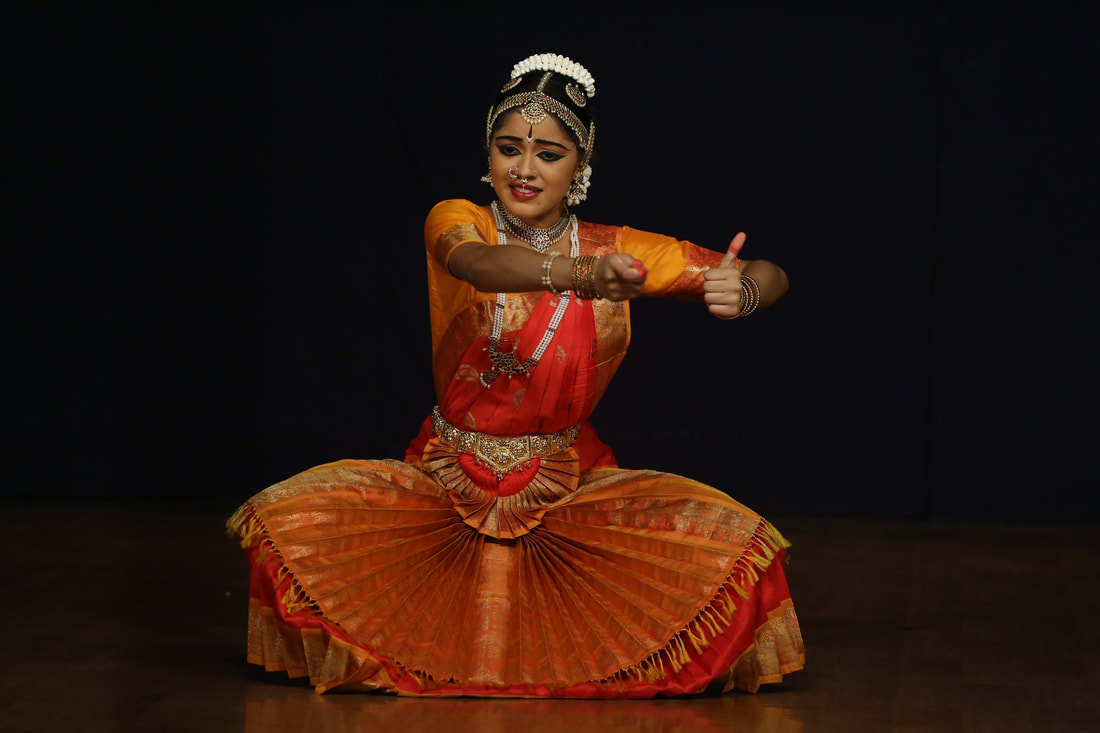
Against all odds, a few families preserved the knowledge of this dance form. Its revival consisted of individuals from disparate backgrounds: Indian freedom fighters, Westerners interested in Indian arts, people outside the devadasi class who learnt Bharatanatyam, and devadasis themselves. 
During the early post-colonial years, India was dealing with its aftermath, poverty and strife and with the immediacy of industrial development, perhaps the national agenda didn’t see it significant to address the override of a community of women, allowing the complete dislodging of their identity. This allowed for a new class to emerge as the saviours of traditional art, renaming it, leaving behind the practitioners to fend with social neglect and the perils of improper implementation of a social and economic reform associated with the Prevention of Dedication act, by themselves.
Bharatanatyam now attracted young artists from respectable Brahmin background. Initially met with shock, their participation helped to shift public opinion in favor of reviving the art. Two such ladies were Kalanidhi Narayanan of Mylapore and Rukmini Devi of Adyar. Their works won over much of the orthodox community of Madras. Their reforms of costume, stage setting, musical accompaniment, and thematic content, won against the objections of conservatives that Bharatanatyam was vulgar. Rukmini Devi went on to found the Kalakshetra institute, to which she attracted many great masters and musicians, with whom she trained generations of dancers.


Over the years, this art form has evolved and transformed in its traditional pride, retaining the original essence of the culture. 
Bharatnatyam dance has made dancing once again significant, so much so that it is now seen as an essential social accomplishment, and has also achieved international recognition as one of India’s treasures.

Thursday, February 2, 2017

Alta, the red color dye in Indian Classical Dance

ALTA, THE RED COLOR DYE FOR INDIAN CLASSICAL DANCER

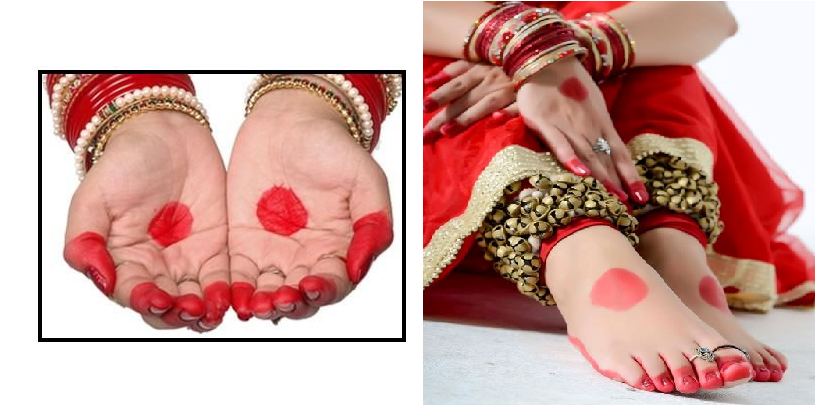
Alta is the bright red color liquid ink applied on the fingers and feet of an Indian Classical dancer. 

Most of the Indian classical dance forms have many meaningful mudras which are symbolic hand gestures used by the dancer to explain and express. 

Please see below some pictures where Altha is used in hand and feet of an Indian dancer.
 

Painting the hands and feet with Alta brings out the beauty of and expressiveness. It is a common practice to paint traditional designs on to hand and feet during festivals, Indian weddings and Hindu poojas.

Alta in olden days was made from betel leaves. It was replaced with artificial products like Sindoor and Kumkum to create similar liquid. In today’s time, the mostly available Alta is made out of chemical colors and is banned in some countries as it can cause severe allergies. Modern dancer use high quality red markers, which are convenient to carry and use. These are safe permanent markers of specific brands and easily washable after the program or ceremony.

Tuesday, September 15, 2015

Bharatanatyam arangetram planning...


Arangetram Planning

I am writing this exactly after a month of my daughter's arangetram. Arangetram is a milestone in the dancer’s and parent’s life which requires a lot of planning. In our case the community and friends were extremely helpfull and all I had to do was to assign the responsibility to my friends. On the day of the arangetram, the only thing I did was walking around and watching things happen. 

Here is the basic planning idea. The timings are approximate and may vary depending upon the teacher, student and the place you live.
About a year before the Arangetram
As a parent, the first thing you want to do is to discuss with the dance guru to know if your child is ready. The readiness for Arangetram depends on the dancer. Some may be ready in 6 years and some may not be ready even after 10 years. A parent may think the child is ready to do it, but you need the teachers view on this definitely.
Have an idea of which month is appropriate to have the Arangetram. Plan to avoid exam time, SAT, ACT or PSAT etc.. vacation time, Major Indian festival times etc…
Think about the music. Discuss with your child and teacher if you need live orchestra or recorded music. If live orchestra is the choice, contact the musicians for a date and shop around. Please visit http://www.dancecostumesandjewelry.com/arangetram/ to get more details about other aspects of live orchestra.
Discuss with teacher about Jewelry and costume types, number of costumes changes etc..Generally two costume changes are fine.
Have a rough estimate on number of guests you are planning to invite.
Based on number of guests, contact local auditoriums and recital halls. Also make sure the orchestra is ok for that time.
Ask around for good photographers and video graphers and shop around. Since you have one year, you can get bargains ! Even though you have one professional video grapher and photographer, please ask couple of your friends to take video and picture. I planned everything, but missed on this part. Please plan on this and I am sure, your friends will be happy to help you.
Think of a time and plan about food depending upon the timings. Ask around friends about food vendors.
If the dancer does not have appropriate dance Jewelry, plan to buy it. 
If you are planning to have chief guests and guest of honor for the arangetram, think of some names and even talk to them about their availability.
About six  Months before Arangetram
Should have signed the contract with the orchestra and the auditorium.
Should have confirmed the chief guests if you were planning on one. 
Plan on costumes. You can buy sarees for the dress. But stitch it only 5 months before the program and get it before the photo shoot. Most young dancers grow and you don’t want to make the arangetram costume a year ago.
Order items for stage and front entrance decoration, if you are planning to do decorations.
If you plan to give gifts, this is a good time to order them
Plan on invitation – Electronic or print. Either case you have to start design it now.
Confirm photographer and videographer
Set a date for photoshoot

3 Months before Arangetram
Should have photos from photo shoot.
Should have confirmed the tickets and travel plan of chief guests
Should have confirmed the staying arrangements of the arangetram orchestra members.
Talk to close friends and families and assign them decoration and food area volunteering works.
Design of the invitation should be started now with pictures,  Orchestra ensemble and chief guests names.
Think about an MC for the program
Talk to the decorating person/contractor.
You should have jewelry, ankle bells and all the make-up accessories.
Complete the guest list.
Send the invitations with RSVP option.
RSVP should be mandated 15 days before the program date.
Sit with the food vendor and get the estimate.
One month before the Arangetram
Buy all the plates, silverware, napkins, glasses, cups etc…
Work on the onstage decoration statues/idols etc..You can borrow them from friends.
Setup a meeting with the theater/auditorium staff and talk about audio and lighting. Use professionals for these two. DO NOT use volunteer friends.
Finalize the arrangement of the dining area.
Collect/buy/order online all items for the arangetram stage decoration and front entrance decoration
Talk to the MC and write the flow of the program and verify it with teacher.
Print and frame the blow up pictures of the dancer if you are planning to do so
Make sure the raiser for the arangetram artists to sit is available in the auditorium. If not, plan to rent one.
2  weeks before the Arangetram
Once again talk to the decoration volunteers and contractors
Make a checklist of everything needed back stage
Make a checklist for everything need for food are
Make a checklist for everything need for the green room
Write all  speeches and  discuss them with teacher and MC
All the lamps and vilakkus need to be Polished
You should have closed the RSVP by now. Call the food vendor and tell the final count
 1 week before the Arangetram
Purchase water, drinks etc…
Order floral arrangements, plants, and floral bouquets.
Remind light and sound people, video and still photographers about rehearsals
Make sure your Iron costumes, check jewelry, ankle bells etc….
Do a rehearsal with live orchestra, 2 days before the program
The previous day of Arangetram
Transport the plates, spoons, napkins etc… and keep them in the dining hall area.
Transport lamps, flowers, pictures and other decoration items and keep them in place.
Have the tables for reception, greeting card box, sweet boxes etc…ready
Finish stage decoration as much as possible
Transport the raiser for the artists to sit and place it on the stage and decorate it.
Keep the chairs for the chief guests near the curtains
Keep two tables ready behind the curtains. One for dancer’s towel, water, juice, touch-up items etc.. and the other for keeping the gifts for the chief guests and artists.
Make sure the podium is decorated.
Keep the Nataraja statue and Vinayaga statue on stage.
Call the food vendor and remind him about the event timings etc. This is very important. I had two food vendors. One of them, who was bringing the tea and vada, came 1 hr late. I told him to be there at 3:30pm because the program was to start at 4:30. He came exactly at 4:30 !!! The program was delayed even though the dancer and orchestra was ready !
Transport water bottles and drink bottles and keep them in the dining area.
The day of Arangetram
Finish stage, foyer and dining hall decorations
Sweep the stage after everyone finished
Call volunteer heads and ask them to arrive at the venue 3 Hrs before the program
 Five hours before
Start the make-up
Start the costume
Give clear instructions to volunteers and assures
Give the audio engineers and musicians enough time to tune the system and equipment. Do a trial run.
Call the before program snacks/tea vendor
Call the volunteers who are driving chief guest and make sure everything is ok...

Thursday, February 5, 2015

Bharatanatyam - Lord Shiva's Dance

Bharatanatyam finds its origins interlocked with classical Indian dance that mimics one of the basic five elements of life. Which when performed is a hypnotizing dance that resembles a flame, to honor Lord Shiva-supreme lord of dance. Traditional dance jewelry worn during the Bharatanatyam dance is known as temple jewelry, which was originally made from gold with rubies, emeralds and pearls. Used by the Devadasi girls as they danced in the temples to honor Lord Shiva original dance.

Artisans created theses authentic masterpieces for centuries in the southern part of India. Even today people revere and covet temple jewelry for its unique beauty and craftsmanship.  Bharatanatyam temple jewelry, combine with the silk multi-functional costume, which becomes enhanced with bells that allow each foot gesture to have a voice. Which seduces and captivates the audience in a mystic trance, As the performer goes through the motions of the dance the costume flows with them. Stimulating the audiences eyes with broad colors, while using body language and hand gestures to portray the ritual dance.

Originally, temple jewelry beautified the gods and goddesses in the temples during the 9th century. Later, women of the South India adopted a liking for the jewelry, which terpsichorean use in their routine to pay respect to their heritage.

There are 10 jewelry pieces that make up the set to do a Bharatanatyam dance: Choker, Long Chain, Mattal, Nath, Bullakku, Ottiyanam, Jimikki, Bangels, Rakkodi, Chandran/Sooryan and Nethichutty. A beginner can get by with a head set, necklace, and belts.  Every piece of the Bharatanatyam performer is essential to the routine even the performers hair dressed with a Chandra (moon shaped) and Surya (sun shaped) ornaments.

The Saree skirt style or Pyjama style which have gold Zari embroidery designs on the skirt. Open when the dancer performs a special posture known as a arai mandi (half-sitting) and muzhu mandi (full sitting). Ever aspect of the beautiful performance ties together giving the audience a breathtaking display meant for a king or god.

Sunday, October 11, 2009

Types of Bharatanatyam Jewelry

Most of the online stores selling Bharatanatyam jewelry has usually three different types of ornamants. The jewelry with red and white stones, imitation temple jewelry, and real temple jewelry. Out of all these, the cheapest is the first catagory. The base metal to make these and imitation temple jewelry are the same. Only the color and type of the stones are different. The real temple jewelry is made of silver and coated with gold. The stones used for this are the kemp stones imported from Srilanka.

Wednesday, September 9, 2009

Temple Jewellery

Temple Jewelry belongs to the tradition of India. Olden days, Temple Jewelry was worn by only Devadasi girls who perform dance in temple and in Darbars. Now a days, it is not uncommon to see south Indian brides wearing Temple Jewellery for their weddings. So today, one can say the Temple Jewellery is traditional South Indian jewellery. The origin of Temple Jewellery dates back to 12th century. This was the period of famous Dravidian Tamil Dynasty known as “Chozha kulam” who ruled southern part of India. All the Chozha kings gave very importance to cultural development and most of the of the temple jewelry today are similar to the designs in the heavily ornamented pillars with accurate details and rich sculpted walls of many south Indian Temples, especially ones in Thanjavur.Today temple jewelry is prepared in a variety of metals. Originally it was made of gold with ruby, emerald & pearls and was used by the devadasi girls who danced in Temple and Darbars. Today Temple jewellery is mostly associated with Bharatanatyam dance. There are different types of Temple Jewellery manufactured today. Three of them are widely sold all over the world. Real Temple Jewellery, Imitation temple Jewellery and stone type temple jewelry. Most of the real temple jewelry is made in Nagercoil, a southern city in Tamilnadu. These designs are quite unique which makes them more popular and adorable. These are made with silver and have a heavy coating of 22Ct gold over it. These are expensive and may not be suitable for young children. Less expensive imitation temple jewellery is also available on the market for those ones who are not yet sure about pursuing a career in dance.The most common imitation temple jewelry has 11 different ornaments. These are Long chain, Short necklace, Sun/Moon, Nethichutti, Mattal, Jimikki, Belt, Vanki, Rakkodi, Nath/Bullakku and bangles. Dancers also wear chilangai/salangai in the ankles during dance performance.