Showing posts with label dance jewelry. Show all posts

Tuesday, January 15, 2019

Temple Jewelry - How do Artisans make it?


Temple Jewelry Making 

Temple jewelry has been a part of south Indian tradition for centuries now. Ancient Tamil literature and its historical writings list many types of jewelry worn by idols, gods and goddesses. The art of jewelry making is known to have originated somewhere in the reign of Chola dynasty in the 9th century, and it was a celebrated form of art all the way through Pandya Dynasty and the Krishnadevaraya rule from the 9th century till the 16th century. This traditional jewelry or temple jewelry is made by using silver or gold as a base engraved and crafted to intricate designs with some precious stones embedded on them. The embedded stones may be dark green or dark reddish maroon in color.

Temple jewellery, an essential part of the adornment of the Tamil bride, is also an integral part of the aharya or costume of a Bharatanatyam or Kuchipudi dancer. Bharatanatyam is one of the classical dances in India which has its origin from religious rituals. Bharatanatyam is one of the oldest and most popular forms of classical in South India. Temple jewelry is important in the form of accessories to the costumes used in Bharatnatyam and Kuchipudi. The bharatnatyam dance jewelry sets are made with dark green & dark maroon –red, quality called kempu stones, also known as temple jewelry. The traditional temple kempu jewelry are the designs worn by Maharanis or Devadasis in the ancient times. Now days they have become fashionable to be worn for wedding, occasions and Indian dance forms like Bharatanatyam , and Kuchupudi. The stones are un-cut polished stones in red & green. Besides being a part of dance costumes and bridal adornment, the deities and idols are also heavily decorated with jewelry.
The temple jewelry is made precisely by hands of traditionally trained artisans. Vadaserry, a tiny village on the outskirts of Nagarcoil is famous of the crafting of traditional temple jewelry. About 60 jewelry making units are working with each of them having about 350 artisans, trained in a traditional way.
Dance Jewelry
Jewelry from www.JewelsAmore.com
The main steps involved in the making of the temple jewelry are:
·         A die of the required shape is made. It contains the engraving and minor detailing work that needs to be in the jewelry. These shapes and details may resemble the figures of deities, parrot, serpent, lotus, motifs, faces of gods and goddesses or any other of the sacred symbols.
·         A gold foil is mechanically worked on the die to give it the shape of the die, working takes place in cold conditions, and no excessive heating of the gold is required. Moreover a sheet of gold is used with relevant thickness.

·         After it has been shaped, the jewelry piece is embedded and embossed with the precious stones ‘kuchu kal’, the precious red or green stones.
·         Final step is giving it a nice surface finish, polishing and an antique finish.
There is a piece of jewelry all the way down from head to toe. Gold is auspicious and considered to be a symbol of health and prosperity. Jewelry pieces are made for forehead, nose, neck, abdomen (belly), upper arm, fore arm, wrist, finger of hands and feet, for ankles, waist, earlobes, etc, covering almost every part visible. Moreover different combinations of jewelry pieces can wear on different occasions, for instance ornaments used by a bharatnatyam dancer are as follows:
1.      Long Necklace
2.      Short Necklace
3.      Hip Chain (Waist Belt)
4.      Head Set (with the sun and moon)
5.       Earring set
6.      Hair to Earring Chain
7.      Hair Clip
8.       Nose Studs
9.       Bangles

As the time has passed by the affordability and accessibility of temple jewelry has changed, the design of jewelry itself has evolved and modified.  These days, silver metal is used as the base for the piece and is later plated with gold. The recreation of the antique gold jewelry has made it affordable for anyone who wants to feel like a part of traditions and cultures. The artisans of Vadaserry also export these pieces of ancient Indian heritage to America, Canada, London, Singapore and Malaysia. The crafting of the temple jewelry is more than just a way for employment and professionalism but also a way for the preservation of the art form for the next generations.


Friday, June 29, 2018

Ghunghroo

A small article written by Ms. Jhankriti on "Ghunghroos". PLEASE READ! ðŸ™‚
Here it is:

Ghunghroo or the Tinker bells are worn by Indian Classical Dancers on their feet for syncing their footwork with the beats of the Tala making Indian Classical Dances much more intricate and unique than the other existing dance forms.
Just like every musician has his/her own instrument, similarly the instrument for a dancer is his/her own Ghunghroos!
Dancers play with their Ghunghroos in a way Musicians play with their instruments.
The melodious sound of the Ghunghroos is a treat to the ears taking the dance of a dancer to a whole new spiritual level!
The grace, elegance and beauty of the Indian Classical Dances is truly unmatched!

If you like my work please like, comment, share and follow my page à¤¨ृत्यनाद by Jhankriti.
Help spread the fragrance of Indian Classical Dance forms far & wide. ☺️

About the writer:
Jhankriti is a trained Indian Classical Kathak dancer who is a Visharad in Jaipur Gharana from Gandharava Mahavidyalaya Mandal, Mumbai. She aims to raise awareness about ancient Indian dance forms through her work. Jhankriti has performed at prestigious venues and regularly shares her thoughts on Indian classical dance on her blog.

Thursday, February 2, 2017

Alta, the red color dye in Indian Classical Dance

ALTA, THE RED COLOR DYE FOR INDIAN CLASSICAL DANCER

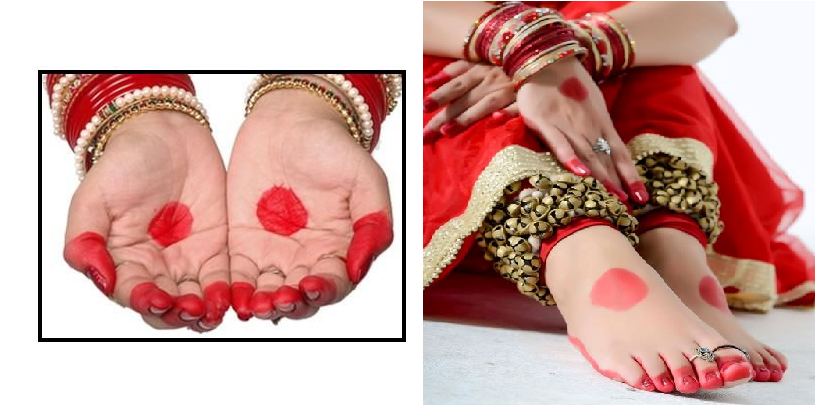
Alta is the bright red color liquid ink applied on the fingers and feet of an Indian Classical dancer. 

Most of the Indian classical dance forms have many meaningful mudras which are symbolic hand gestures used by the dancer to explain and express. 

Please see below some pictures where Altha is used in hand and feet of an Indian dancer.
 

Painting the hands and feet with Alta brings out the beauty of and expressiveness. It is a common practice to paint traditional designs on to hand and feet during festivals, Indian weddings and Hindu poojas.

Alta in olden days was made from betel leaves. It was replaced with artificial products like Sindoor and Kumkum to create similar liquid. In today’s time, the mostly available Alta is made out of chemical colors and is banned in some countries as it can cause severe allergies. Modern dancer use high quality red markers, which are convenient to carry and use. These are safe permanent markers of specific brands and easily washable after the program or ceremony.

Thursday, February 5, 2015

Bharatanatyam - Lord Shiva's Dance

Bharatanatyam finds its origins interlocked with classical Indian dance that mimics one of the basic five elements of life. Which when performed is a hypnotizing dance that resembles a flame, to honor Lord Shiva-supreme lord of dance. Traditional dance jewelry worn during the Bharatanatyam dance is known as temple jewelry, which was originally made from gold with rubies, emeralds and pearls. Used by the Devadasi girls as they danced in the temples to honor Lord Shiva original dance.

Artisans created theses authentic masterpieces for centuries in the southern part of India. Even today people revere and covet temple jewelry for its unique beauty and craftsmanship.  Bharatanatyam temple jewelry, combine with the silk multi-functional costume, which becomes enhanced with bells that allow each foot gesture to have a voice. Which seduces and captivates the audience in a mystic trance, As the performer goes through the motions of the dance the costume flows with them. Stimulating the audiences eyes with broad colors, while using body language and hand gestures to portray the ritual dance.

Originally, temple jewelry beautified the gods and goddesses in the temples during the 9th century. Later, women of the South India adopted a liking for the jewelry, which terpsichorean use in their routine to pay respect to their heritage.

There are 10 jewelry pieces that make up the set to do a Bharatanatyam dance: Choker, Long Chain, Mattal, Nath, Bullakku, Ottiyanam, Jimikki, Bangels, Rakkodi, Chandran/Sooryan and Nethichutty. A beginner can get by with a head set, necklace, and belts.  Every piece of the Bharatanatyam performer is essential to the routine even the performers hair dressed with a Chandra (moon shaped) and Surya (sun shaped) ornaments.

The Saree skirt style or Pyjama style which have gold Zari embroidery designs on the skirt. Open when the dancer performs a special posture known as a arai mandi (half-sitting) and muzhu mandi (full sitting). Ever aspect of the beautiful performance ties together giving the audience a breathtaking display meant for a king or god.

Sunday, August 25, 2013

Traditional indian dance form

Author: Ranjana Banerjee

TRADITIONAL INDIAN DANCE FORM:
Dance is an ancient and revered Indian art form that is traditionally linked to mythology and classical literature. Historically, accomplished artists were a matter of prolific pride among royal houses; the quality of their respective dance troupes was at one stage the cause of intense competition between the maharajas of Mysore and Travancore. Between the 2nd and 8th centuries, trade between South India and Southeast Asia brought a cultural legacy that endures in the dance forms of Bali (Indonesia), Thailand, Cambodia and Myanmar (Burma). Today dance-classical, popular and folk-thrives on city stages, on the cinema screen and in towns and villages throughout South India.
India has a very rich tradition of classical dance. Each form has its own specialty & grace, along with a set pattern of costumes & make-up. Today the acknowledged classical styles are:
1.Bharatanatyam, is a classic dance form originating in Tamil Nadu, a state in South India and is the known as the Indian National Dance. This dance form is a 20th century reconstruction of Cathir, the art of temple dancers. Cathir in turn, is derived from ancient dance forms. Bharatanatyam is usually accompanied by the classical Carnatic music. Bharatanatyam is considered to be a fire-dance - the mystic manifestation of the metaphysical element of fire in the human body. The movements of an authentic Bharatanatyam dancer resemble the movements of a dancing flame
2.Kathak, originated from Northern India. This dance form traces its origins to the nomadic bards of ancient northern India, known as Kathaks, or story tellers. These bards, performing in village squares and temple courtyards, mostly specialized in recounting mythological and moral tales from the scriptures, and embellished their recitals with hand gestures and facial expressions. It was quintessential theater, using instrumental and vocal music along with stylized gestures, to enliven the stories.
3.Kathakali, is a highly stylised classical Indian dance-drama noted for its attractive make-up of characters, their elaborate costumes, detailed gestures and well-defined body movements presented in tune with the anchor playback music and complementary percussion. It originated in the country's southern state of Kerala during the 16th century AD, approximately between 1555 and 1605, and has been updated over the years with improved looks, refined gestures and added themes besides more ornate singing and precise drumming.
4.Kuchipudi (pronounced as ‘Koochipoodi'), is a Classical Indian dance form from Andhra Pradesh, a state of South India. The movements in Kuchipudi are quicksilver and scintillating, rounded and fleet-footed .Specifically there is the Tarangam of Kuchipudi which is unique in that the dancer must dance upon a brass plate, placing the feet upon the raised edges. The dancer moves the plate with much balance as the individual is traditionally dancing on the plate with two diyas (small oil-burning candles) in his or her hands while balancing a "kundi" (small vessel) containing water on their head. At the end of the dance, typically, the dancer extinguishes the candles and washes his or her hands with the water from the vessel.
5.Manipuri, dance is one of the major Indian classical dance forms. It originates from Manipur, a state in north-eastern India on the border with Myanmar (also known as Burma). The traditional Manipuri dance style embodies delicate, lyrical and graceful movements. The feet move is viewed as part of a composite movement of the whole body. The dancer's feet are neither put down nor lifted up at the precise rhythmic points of the music but rather slightly earlier or later to express the same rhythmic points most effectively
6.Mohiniyattam, is a traditional South Indian dance form Kerala, India. It is a very graceful dance meant to be performed as a solo recital by women. The term Mohiniyattam comes from the words "Mohini" meaning a woman who enchants onlookers and "aattam" meaning graceful and sensuous body movements. The word "Mohiniyattam" literally means "dance of the enchantress".
7.Odissi, is one of the classical dance forms of Originates from the state of Orissa, in eastern India. The classic treatise of Indian dance, Natya Shastra, refers to it as Odra-Magadhi. It is particularly distinguished from other classical Indian dance forms by the importance it places upon the tribhangi (literally: three parts break), the independent movement of head, chest and pelvis, and upon the basic square stance known as chauka.
8.Sattriya, the core of Sattriya Nritya has usually been mythological stories. This was an artistic way of presenting mythological teachings to the people in an accessible, immediate, and enjoyable manner. Traditionally, Sattriya was performed only by bhokots (male monks) in monasteries as a part of their daily rituals or to mark special festivals. Today, in addition to this practice, Sattriya is also performed on stage by men and women who are not members of the sattras, on themes not merely mythological.
The true traditional Indian dance, it has to be stated clearly, is not a vulgar form of entertainment but a sacred ritual that is supposed to bring the rasanubhava (catharsis, or spiritual upliftment) to the rasika (audience) and the dancer.
Most of the contemporary choreographers and dancers may use some of the formal traditional Indian dance technique or its elements to stage ballets presenting various themes such as nationalism, unity of religions, the sanctity of the environment, the animal rights activism, or a political party for a social cause.
http://www.eslarrenterprise.co.in/blog
Article Source: http://www.articlesbase.com/dance-articles/traditional-indian-dance-form-5490396.html
About the Author
Completed ISC from a reputed English medium school in Kolkata in the year 2002 with 85%+. Fashion & beauty is in my blood as my mother who is sole inspiration of Eslarr Enterprise, incorporated in the year 1978 is now a renowned manufacturer and exporter of Indian Ethnic Dresses.
I have also studied kathak for 6 years while I am in school. I am experimented with whatever seemed interesting. I will try anything once. I believe that if God gives you talent, don't be ungrateful. Use it.
 

Thursday, August 1, 2013

Dance Jewelry online in India

Shopping for dance jewelry in Chennai, Bangalore, Hyderabad or in any other cities like Mumbai, Delhi or Calcutta is becoming a bit cumbersome process lately. Many of us do not know where the shops are. Even if you know the street where all the dance accessory stores are located, you don't know which one is trust worthy ! Out of a few vacation days, you struggle to get there in time because of the traffic and distance etc...Finally when you get there the stores are crowded and you will not find your personal space to chose what you really need.

Fine, you can look at the dance jewelry carefully, select the model you need and pick and chose the best finished one because you are seeing it. Finally you are forced to take what ever is available. But for most of the stores, once buy and come out, there is no way for you go back and return it if your child or the dancer didn't like it !  You will see a big board in every store saying "All the sales are final. No returns or refund"

There is no customer friendly approach in many shops. That is when most of the customers go look for an online store. We have couple of online stores selling dance jewelry in India and abroad. The web store www.DanceJewelryOnline.com offers all types of Indian Classical dance jewelry and costumes for very reasonable price. The shipping service is fast depending upon the service you pay for.  Usually you get the jewelry with 5~6 business days.

This store has readymade classical dance costumes too. Please click here to see the variety of dresses they have. The catalog includes Bharatanatyam dance dress, kuchipudi costumes, Kathak dance dress, Odissi dance dress and Mohiniyattam dance costumes. Readymade dress is usually delivered within 4 weeks.

Friday, January 4, 2013

Kundan Jewelry Designs


Traditional Kundan Jewelry is one of the oldest form of gemstone jewelry in Indian. This type of jewelry uses a gem set with thin gold foil between the jewelry base mount and the gem stone. Usually the gem stone is placed in the mount and secured with gold foil between the gaps. Originated in Rajastan and Gujarat, Kundan jewelry is the most beautiful and loved jewelry in north India.


Jaipuri Jewelry is another form of Kundan jewelry in which the Kundan gemstone setting is in the front and enamel designs on the back of the jewellery bits. This is also called as Meenakari Kundan jewelry or Bikaneri Jewelry. Jaipur is the main source of Meenakari Kundan jewelry and Bikaneri Kundan Jewelry in India.

These are some of the designs of Kundan jewelry we have in our online store. Please have a look.

Kundan Jewlery

Thursday, September 22, 2011

Who gave you the right to abuse Indian culture in the name of culture?

I have to share this incident with all people who are true art lovers and understand Indian culture in the real sense. Well, this happened just a couple of days back and I was witness to an unnerving night of celebration. When I came out of the door after the event, just wondered what was celebrated and what was propagated?
As children we grew up learning that our rich heritage, our way of life and Art is our culture, today where do we get to see them, it is certainly a rarity. I planned for about a week ahead to make sure that I did not miss this cultural event which celebrates and propagates Indian Art and culture, this is an event organized by a legitimate Organization as part of their cross cultural Initiative, excited all week long looked forward to it and finally the day came, they had a regular meet and greet gala and the program started at 4.30PM, which I am glad started on time. The program started with a welcome speech and the first inaugural program as per the brochure distributed said Indian classical dance form and there comes the compere announcing a brief version of the richness of this classical dance…wow what just happened, classical dance to a Amir khan Bollywood song, this is not culture my dear, this is Bulture straight from Bollywood. I had loads of laughter; I had more adventure coming my way. Next is again a classical dance form from India, what was it this time, not surprised and advertisement commercial straight from the TV promoting Indian tourism of Kerala…hmmm good job all in the name of culture, this is how one can get away doing anything without stuff and the only skill you need is just be “street smart”. Another aspect worth mentioning is about, choreography and clothes, both the C’s were nowhere close to aesthetics, this is a easier strategy to getting famous faster in today’s time, sad that this strategy is gone beyond movies….
The next part of the program got more interesting with sheer murder of our folk dance forms, thanks to Bollywood dance and music which is like one size fits all; the next piece was the highlight with the dancer claiming to have a legitimate qualification, but has no teacher name or institute to talk about both in her profile nor in her compere, more like an “Anonymous type”. Well the only thing we could figure out that she was trying to attempt a very famous classical dance form, but to a disgrace it turned to be a sad version of a YouTube video of a very famous dancer from India who is considered as a great artist from India and recognized worldwide. How desperate can one get to be in the face of audience? Copy wow…

After all this, I just lived thru and was alive, then came this performance of a good artist, she stole the show, her presence for 10 mins took away all the pain that I went thru for the last 50 mins. She is a true dance lover and we could experience that throughout her performance. Kudos to her but I also feel sad that she had to share stage space with a very substandard lot of performers. Hence she stands to be ‘Best in the Worst’.

Coming back to my question, who are we - an individual an institute, who has this right to abuse Indian art and culture in the name of Culture? I strongly believe that there is right and wrong to everything, then stand up and have the guts to say we promote Bollywood why Classical. The word classical is such a divine part of our rich culture so closely woven to our heart through our Dance and Music, why does anybody want to showcase this in a wrong way on any platform?
I am so confused that we ourselves are bent upon damaging our identity and portraying this completely different from what it is, to other people leave alone people from other cultures what is happening to people from our culture who are day in and out either approving, acknowledging, witnessing, participating in such gruesome act of tarnishing our Indian Culture…  

This is what I felt like inking to all of you as an artist, art lover, critic whatever if not anything just an Indian who loves her country and the core values of who we are and what makes us unique from others…

At the end I am left with no answer but one question are we so beyond anything that we believe “any crap can sell”? If yes, all those dear legitimate organizations/ committee’s, just sit back once to think what happens to all those people who worked, are contributing unconditionally in passing on this rich art form with at most humbleness to our future generations…do we have any responsibility at all??? Please realize that if you are not directly qualified to contribute to art and culture, we all can still make a small difference in this world in our own capacity, and so NO to anything that may cause a smudge to the glowing culture.

Dance Guru
USA

Saturday, July 2, 2011

Sree Padmanabha Swamy Temple will be the richest Hindu Temple in the world

Sree Padmanabha Swamy Temple will the richest Hindu temple in the entire world !!! As of last week, while the stock taking was only 70% complete, the estimated value of thousands of precious stones, Gold necklaces, Gold deities and other valuable jewelry were about 11 billion US dollars.

Other items found today includes several Gold statues each weighing almost 5 pounds and Gold Jewelry necklaces as long as 3.5 meters and crowns decorated with Emeralds, Diamonds and Rubies. They also found a 4 feet tall statue of Lord Vishnu made of Gold.

It was identified by a special committee appointed by Supreme court that temple has a total of six chambers. With couple of chambers yet to be opened and the first chamber accounting ending Saturday (2 July 2011), it is expected that the inventory process may continue for a few more days.

The list of Jewelry and other valuables in the treasure found in Sree Padmanabhaswamy Temple are:

Hundred thousand Gold Coins, Precious Diamonds like Indraneelam, Belgium Diamonds, Emeralds, Rubies,
Thousand Sarappoli Gold Chains, Rare Priceless Gems, Gold Crowns like Kulashekharaperumal Crown,
Kashu Mala Necklaces, 400 Gold Necklaces with Marathakam stone, Gold Plates (Swarna Thalika), Gold Chains of about 18 ft, Golden Idol of Padmanabha Swamy, Gold Dhanuss, Gold Pathakams, 4 Feet tall Golden statue of Lord Vishnu with precious emeralds, Golden Umbrellas, Gold Pots, Kumbheeyam, Gold/Silver Nilavilakku, Other Kerala traditional Jewelry of various kind.

Hope all the wealth is used for good purpose / growth of the state and the polititians do not steal it as usual.

Sunday, January 30, 2011

Bharatanatyam costume color selection

At http://www.dancecostumesandjewelry.com/  you can submit the measurements accurately online and select the color of dance costumes as you wish. There is no limitation. In fact you can even upload a photo of the sample dance dress you have in mind too. We have tailors in different states in India. Most of our Bharatantyam dresses are stitched in Chennai and the Kuchipudi dresses are stitched in Hyderabad. Here are some samples of fast moving dress colors we do. This is to just give you an idea. We do not limit the color combination or style of the dance dress as we mentioned earlier. We have skirt style and pant style Bharatanatyam dress. Also we have 2 fan and 3 fan Bharatanatyam dance costumes. In our online store, you decide the color, style and the material. We make sure you get what you want in time.

Also we have many designs of imitation and real temple jewelry for Bharatanatyam and Kuchipudi dance styles

Below we have shown some art silk material Bharatanatyam costumes.


To see more models and pictures, please visit http://www.dancecostumesandjewelry.com/ and explore the possibilities.


We will update more photos of other dance styles.

Till then - have fun dancing...

Team http://www.dancecostumesandjewelry.com/

Friday, June 25, 2010

Ankle Bells from DanceJewelryOnline.com

Have you ever looked at the different models of Ghungroo we have in our online store? We have almost all the best quality ankle bells available in South India in our website. The Ankle bells are known as “Salangai” in Tamil and “Chilanka” in Malayalam. Basically they are two types – Leather and cloth. There is one more less popular type made of Rexin also. As you know, the quality and confort of these are not well known.
Ankle bells made of genuine leather are very comfortable to wear and knwon to last long – you may get bored with them before they start tear apart. These have cushion pads behind, where it comes into contact with your ankle and so are very comfortabe to wear during hours of long practice or performance. The buckles, once fastened won’t come apart and are worry free. Some dancers prefer cloth type and would like to tie the Ghungroos instead if buckle them up.
The size of the Salangai depends upon the number of bells in each of them. It is appropriate to wear a two line Ankle bell for a seven or eight year old dancer, while adults prefer to have a four or five line Ghungroo. Based on the size, the number of bells in the Ghungroo will change. A good quality Ankle bell will have atleast 10 bells in each line. There fore, a 4 line Ghungroo will have about 40 bells in one pad. The quality of sound depend upon the size of the individual bell. The small size bells make less sound since the ball inside the bell is also small and its movement is lesser than that of a big bell.
Ankle bell coming off from the dancers leg during a performance is considered as a bad sign. Also it is dangerous and may injure the dancer. So it is important to select a good quality Ankle bell and one should make sure it is fastened or tightened properly before the dancer goes to the stage.

Tuesday, February 23, 2010

Indian Classical Dance makeup

The Indian classical dance makeup should have a graceful look and should be suitable for stage light rather than day light. It also should be equally suitable for dancers with dark or fair skin colors.

Make-up may smudge! Keep your face oil-free. Some dancers become very emotional just before the dance – but don’t cry!!!

Below is the list of Items you need for Indian Classical Dance makeup. This is applicable for Bharatanatyam, Mohiniyattam, Kathak and Kuchipudi.

Note: All the items except the items in the first line are available in any makeup kit available from Wal-Mart or Target

Altha, Sindoor, Kumkum, Bindi (preferably Maroon color)
Blush
Eye shadow
Facial powder / Talcum powder (inhaling or swallowing talcum powder is dangerous)
Light foundation

Indian dance makeup – step by step procedure:

  1. Using a gentle soap wash face and wipe with a soft lint free cotton cloth
  2. Apply an oil-free moisturizer. We recommend you to use herbal moisturizer. Remember, chemicals are harmful !
  3. Apply a light coat of facial powder
  4. Apply the foundation. This can be a nice thick (just noticeable) coating. The foundation color should be little bit lighter than your skin color
  5. Over the foundation, apply a coat of facial powder
  6. Now apply blush
  7. Draw the outline of both eyes using black eyeliner. Make sure the end of the outline is curved so that the eyes appear like a lotus petal.
  8. Apply multiple coats of black mascara
  9. On the nose, especially on the sides, apply dark foundation to the sides of your nose.
  10. Select an appropriate color lipstick with some gloss and apply
  11. Place a maroon sticker Bindi in the middle of your fore-head. For round face, use a rain drop shaped bindi. For a long face, use a round bindi
Hair makeup is a different topic and it varies depending upon the dance style. However, irrespective of the dance style, all uses false hair and hair kunjalam. We will cover the hair makeup in a separate blog.


Sunday, October 11, 2009

Types of Bharatanatyam Jewelry

Most of the online stores selling Bharatanatyam jewelry has usually three different types of ornamants. The jewelry with red and white stones, imitation temple jewelry, and real temple jewelry. Out of all these, the cheapest is the first catagory. The base metal to make these and imitation temple jewelry are the same. Only the color and type of the stones are different. The real temple jewelry is made of silver and coated with gold. The stones used for this are the kemp stones imported from Srilanka.