Monday, August 3, 2020

Transformation of Devadasi Dance to Modern Bharatanatyam Dance!

The term Bharatanatyam today describes a particular style of dance. Factually, Bharatanatyam is a system of dance, described in the Natya Shastra, capable of manifesting various forms. Four related but distinct kinds conforming to the system of Bharatanatyam are:

Sadir Natyam – a solo dance type performed for centuries by devadasis in temples and eventually in the royal courts of South India, especially in Tamil Nadu. 
Bhagavata Melam – a group form of dance drama from Tamil Nadu, with all roles performed by men, and themes based on folklore. 
Kuravanji – a group dance by women, interpreting poetic compositions typically on the theme of fulfillment of the love of a girl for her beloved. 
Kuchipudi – a group form of dance drama from Andhra Pradesh, with all roles performed by men, and themes based on folklore. 
While a number of India’s dance types, like Manipuri, Mohini Attam, Yakshagana, and Kathakali, can be considered variations of the system of Bharatanatyam, they are not as firmly rooted in it as the four listed above.

The birth of this art form as well as the donning of these traditional costumes traces its ancestry way back to the 17th century, wherein Devadasis, who were temple dancers, practiced Bharatnatyam (Sadir Natyam) to worship gods and goddesses. In Southern India, a devadasi was a female artist who was dedicated to worship and serve a temple for the rest of her life. The adhesion took place in a Pottukattu ceremony that was somewhat similar to a marriage ceremony. In addition to taking care of the temple and performing rituals. After becoming Devadasis, the women would spend their time learning religious rites, rituals, dances, etc. They were expected to live a life of celibacy, however, there have been instances of exceptions. The absolute origin of the Devadasi tradition is unknown. The first known mention of a Devadasi is to a girl named Amrapali, who was declared nagarvadhu by the king during the period of the Buddha.
Devadasis wore heavy studded and embroidered saris and were depicted as celestial dancers who performed this classical art dance on earth.

Devadasi would perform the dance daily at the time of worship, and it came to be patronized by the Rajas and the princes. In the course of time, they began performing in the royal courts and thus its religious sanctity was lost.

This unique classical dance tradition deteriorated in the North due to repeated foreign invasions, and mixed dance forms replaced it. Luckily, the dance tradition survived in South India, where it continued to be patronized by kings and maintained by the devadasi system. However, under British rule, propaganda prevailed against Indian art, misrepresenting it as crude, unscrupulous, and inferior to the concepts of Western civilization. This influence was pervasive enough to dissuade the patronage of royal courts for ritual temple dances, and to transfer educated Indians from their traditions. The Madras Presidency under the British colonial government ruled out the custom of dancing in Hindu temples in 1910 and with this, the age-old tradition of this classical dance of South India was almost wiped out, even in Tamil Nadu.
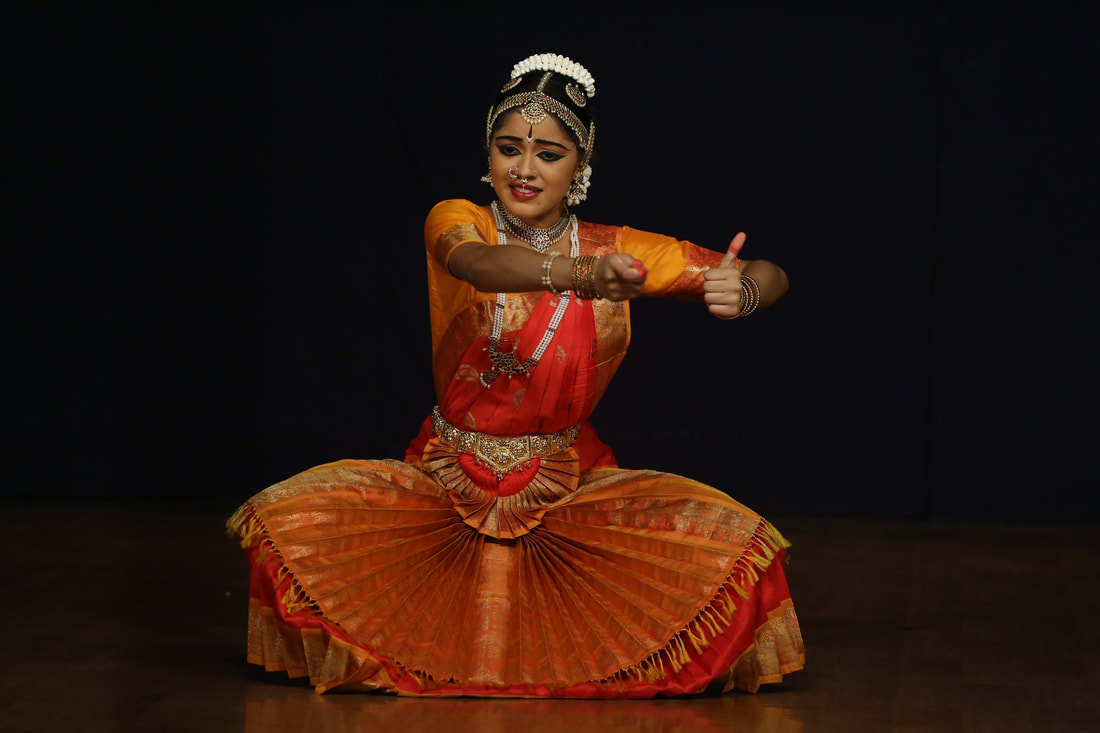
Against all odds, a few families preserved the knowledge of this dance form. Its revival consisted of individuals from disparate backgrounds: Indian freedom fighters, Westerners interested in Indian arts, people outside the devadasi class who learnt Bharatanatyam, and devadasis themselves. 
During the early post-colonial years, India was dealing with its aftermath, poverty and strife and with the immediacy of industrial development, perhaps the national agenda didn’t see it significant to address the override of a community of women, allowing the complete dislodging of their identity. This allowed for a new class to emerge as the saviours of traditional art, renaming it, leaving behind the practitioners to fend with social neglect and the perils of improper implementation of a social and economic reform associated with the Prevention of Dedication act, by themselves.
Bharatanatyam now attracted young artists from respectable Brahmin background. Initially met with shock, their participation helped to shift public opinion in favor of reviving the art. Two such ladies were Kalanidhi Narayanan of Mylapore and Rukmini Devi of Adyar. Their works won over much of the orthodox community of Madras. Their reforms of costume, stage setting, musical accompaniment, and thematic content, won against the objections of conservatives that Bharatanatyam was vulgar. Rukmini Devi went on to found the Kalakshetra institute, to which she attracted many great masters and musicians, with whom she trained generations of dancers.


Over the years, this art form has evolved and transformed in its traditional pride, retaining the original essence of the culture. 
Bharatnatyam dance has made dancing once again significant, so much so that it is now seen as an essential social accomplishment, and has also achieved international recognition as one of India’s treasures.

Tuesday, January 15, 2019

Temple Jewelry - How do Artisans make it?


Temple Jewelry Making 

Temple jewelry has been a part of south Indian tradition for centuries now. Ancient Tamil literature and its historical writings list many types of jewelry worn by idols, gods and goddesses. The art of jewelry making is known to have originated somewhere in the reign of Chola dynasty in the 9th century, and it was a celebrated form of art all the way through Pandya Dynasty and the Krishnadevaraya rule from the 9th century till the 16th century. This traditional jewelry or temple jewelry is made by using silver or gold as a base engraved and crafted to intricate designs with some precious stones embedded on them. The embedded stones may be dark green or dark reddish maroon in color.

Temple jewellery, an essential part of the adornment of the Tamil bride, is also an integral part of the aharya or costume of a Bharatanatyam or Kuchipudi dancer. Bharatanatyam is one of the classical dances in India which has its origin from religious rituals. Bharatanatyam is one of the oldest and most popular forms of classical in South India. Temple jewelry is important in the form of accessories to the costumes used in Bharatnatyam and Kuchipudi. The bharatnatyam dance jewelry sets are made with dark green & dark maroon –red, quality called kempu stones, also known as temple jewelry. The traditional temple kempu jewelry are the designs worn by Maharanis or Devadasis in the ancient times. Now days they have become fashionable to be worn for wedding, occasions and Indian dance forms like Bharatanatyam , and Kuchupudi. The stones are un-cut polished stones in red & green. Besides being a part of dance costumes and bridal adornment, the deities and idols are also heavily decorated with jewelry.
The temple jewelry is made precisely by hands of traditionally trained artisans. Vadaserry, a tiny village on the outskirts of Nagarcoil is famous of the crafting of traditional temple jewelry. About 60 jewelry making units are working with each of them having about 350 artisans, trained in a traditional way.
Dance Jewelry
Jewelry from www.JewelsAmore.com
The main steps involved in the making of the temple jewelry are:
·         A die of the required shape is made. It contains the engraving and minor detailing work that needs to be in the jewelry. These shapes and details may resemble the figures of deities, parrot, serpent, lotus, motifs, faces of gods and goddesses or any other of the sacred symbols.
·         A gold foil is mechanically worked on the die to give it the shape of the die, working takes place in cold conditions, and no excessive heating of the gold is required. Moreover a sheet of gold is used with relevant thickness.

·         After it has been shaped, the jewelry piece is embedded and embossed with the precious stones ‘kuchu kal’, the precious red or green stones.
·         Final step is giving it a nice surface finish, polishing and an antique finish.
There is a piece of jewelry all the way down from head to toe. Gold is auspicious and considered to be a symbol of health and prosperity. Jewelry pieces are made for forehead, nose, neck, abdomen (belly), upper arm, fore arm, wrist, finger of hands and feet, for ankles, waist, earlobes, etc, covering almost every part visible. Moreover different combinations of jewelry pieces can wear on different occasions, for instance ornaments used by a bharatnatyam dancer are as follows:
1.      Long Necklace
2.      Short Necklace
3.      Hip Chain (Waist Belt)
4.      Head Set (with the sun and moon)
5.       Earring set
6.      Hair to Earring Chain
7.      Hair Clip
8.       Nose Studs
9.       Bangles

As the time has passed by the affordability and accessibility of temple jewelry has changed, the design of jewelry itself has evolved and modified.  These days, silver metal is used as the base for the piece and is later plated with gold. The recreation of the antique gold jewelry has made it affordable for anyone who wants to feel like a part of traditions and cultures. The artisans of Vadaserry also export these pieces of ancient Indian heritage to America, Canada, London, Singapore and Malaysia. The crafting of the temple jewelry is more than just a way for employment and professionalism but also a way for the preservation of the art form for the next generations.


Friday, June 29, 2018

Ghunghroo

A small article written by Ms. Jhankriti on "Ghunghroos". PLEASE READ! ðŸ™‚
Here it is:

Ghunghroo or the Tinker bells are worn by Indian Classical Dancers on their feet for syncing their footwork with the beats of the Tala making Indian Classical Dances much more intricate and unique than the other existing dance forms.
Just like every musician has his/her own instrument, similarly the instrument for a dancer is his/her own Ghunghroos!
Dancers play with their Ghunghroos in a way Musicians play with their instruments.
The melodious sound of the Ghunghroos is a treat to the ears taking the dance of a dancer to a whole new spiritual level!
The grace, elegance and beauty of the Indian Classical Dances is truly unmatched!

If you like my work please like, comment, share and follow my page à¤¨ृत्यनाद by Jhankriti.
Help spread the fragrance of Indian Classical Dance forms far & wide. ☺️

About the writer:
Jhankriti is a trained Indian Classical Kathak dancer who is a Visharad in Jaipur Gharana from Gandharava Mahavidyalaya Mandal, Mumbai. She aims to raise awareness about ancient Indian dance forms through her work. Jhankriti has performed at prestigious venues and regularly shares her thoughts on Indian classical dance on her blog.

Wednesday, September 6, 2017

Traditional dress and Jewelry of Kerala

Breathtaking Traditional Dress and Jewelry of Kerala
The traditional dressing sense of Kerala people is a vivid beauty description of their landscape and cuisine. The traditional woman Saree costumes adorned with lots of jewelry from her waistline to the neck. People of Kerala live serenity and peace, and hence their traditional wear is off-white or pure white. Each occasion like their traditional festivals and marriage comes with new attire that reflects the time of the day.
Women Traditional Dress and Costume
Women of Kerala and especially the Hindu women are known to wear traditional Kerala Saree that is off-white with golden Kasavu Border. The Saree is a unique set of separate clothes referred to as the Neriyathy and Mundu. The Mundu is used to cover the lower part of the woman body while the Neriyathy for the top part. The most expensive and exquisite ones are usually worn on special occasions. For the Christian women of Kerala, they wear the same design of mundu with a small extension in the back that looks like a fan and the blouse that accompanies Mundu is known as Chatta. The Muslim women are known to wear Purdah, a long gown that looks like a dress and covers the entire body. The older Muslim women of Kerala are known to wear Mundu with a colorful blouse known as Chatta and a head gear Neriathu to cover their heads.
The Kerala women wear the set mundu for their traditional dance Thiruvathira during Onam celebrations.

Men traditional costumes
The Men of Kerala are known to wear a bottom called Dhoti or Mundu accompanied by a unique designed Jubbah or shirt. Men also have a casual bottom wear known as Lungi, however, in the recent years, the people have adjusted to the taste and designs of western wear. The older generation men have maintained their traditions, and they do not wear any shirt instead they love to drape a cloth known as Mel-Mundu that covers their upper body.

Traditional wedding costumes
The traditional costumes for brides in Hindu marriages in Kerala are sarees which have different shades and bright colors adorned with heavy embroidery work. Most women during their wedding prefer the Kanchipuram silk sarees. The sarees embellished with stones, crystal work, and beads and they come in colors like maroon, green, red, orange, etc. The colors of each sarees are carefully chosen according to the auspicious day. Men prefer to wear silk dhoti or a Kasavu mundu and a shirt.
Kerala is also famous for the hand-woven sarees (Kai Thari) that are done in the villages to create a unique handloom sarees. For the young ones, they love the traditional half sarees and also the Pattu Pavada that are either plain or silk.

Kerala Jewelry
Any attire in Kerala is not complete without jewelry. They love wearing gold and not just one, but many gold ornaments are part of their traditional costumes and especially during festivals. During marriages, gold jewelry is an integral component. The old traditional jewelry worn includes the Palakka Mala, Kasu Mala, Addiyal, Nagapada Thali, Mullamottu Mala, Karimani Mala, Cheruthali, Kashali, Jhimki, Manga Mala, etc.

Other than the bridal and other festival jewelry, the people of Kerala also have jewelry individually adorned for their gods in the temples. This jewelry is known as Thiruvabharnam, and it is sacred.  The older generation of men used to pierce their ears and put on small gold stud known as Kadukkan. The Mulla Mottu Mala is a necklace that looks like jasmine buds, and it usually has gold or precious stones of different colors or beads. The ankles are either made of silver or gold.

Kerala has unique and stunning traditional costumes and Jewelry.

Thursday, February 2, 2017

Alta, the red color dye in Indian Classical Dance

ALTA, THE RED COLOR DYE FOR INDIAN CLASSICAL DANCER

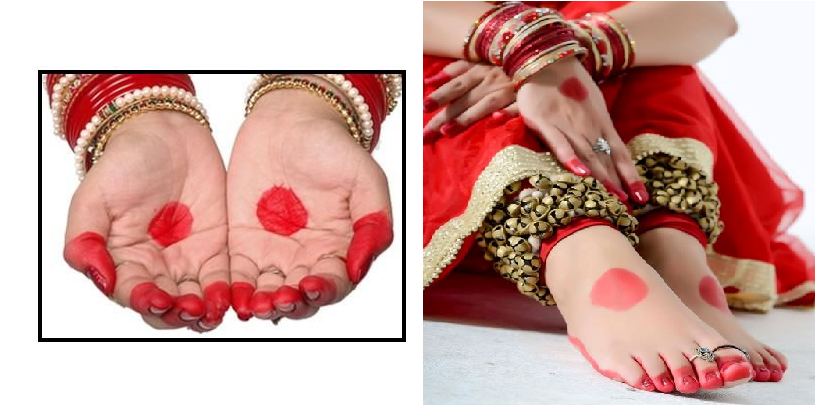
Alta is the bright red color liquid ink applied on the fingers and feet of an Indian Classical dancer. 

Most of the Indian classical dance forms have many meaningful mudras which are symbolic hand gestures used by the dancer to explain and express. 

Please see below some pictures where Altha is used in hand and feet of an Indian dancer.
 

Painting the hands and feet with Alta brings out the beauty of and expressiveness. It is a common practice to paint traditional designs on to hand and feet during festivals, Indian weddings and Hindu poojas.

Alta in olden days was made from betel leaves. It was replaced with artificial products like Sindoor and Kumkum to create similar liquid. In today’s time, the mostly available Alta is made out of chemical colors and is banned in some countries as it can cause severe allergies. Modern dancer use high quality red markers, which are convenient to carry and use. These are safe permanent markers of specific brands and easily washable after the program or ceremony.

Tuesday, May 10, 2016

Arangetram orchestra artists of 2016 tour

Smt. Mytreyi Aravind, Vocal
Smt. Mytreyi Aravind (more known as S.R.Mytreyi), is a disciple of "Padma Bhushan" "Sangeetha Kala Acharya" "Kalaimamani" Sri P.S. Narayanaswami and "Kalaimamani" Dr Rukmini Ramani. Mytreyi was sown the seeds of Carnatic Music at a very tender age. She hails from a family of Attorneys and great connoisseurs of music. Her father Sri S R Ramkrushna Sastry was a disciple of "Sangeetha Kalanidhi" Late Sri D. K. Jayaraman. Mytreyi's quest for music is limitless and she desires to innovate while keeping traditions alive and intact. 
Arangetram orchestra
Smt. Mytreyi Aravind
Mytreyi has performed in almost all the prestigious stages in India like The Music Academy (Chennai), Sri Shanmukhananda Sangeetha Sabha (Mumbai), Kamani Auditorium (New Delhi), Narada Gana Sabha (Chennai), Kartik Fine Arts (Chennai), The Mylapore Fine Arts Club (Chennai), Rajalakshmi Fine Arts (Coimbatore) to name a few.

She's an A graded artiste of the All India Radio, Chennai. She has presented many concerts on AIR and Doordarshan. Mytreyi currently resides in the United States of America where she pursues her music with the able support of her husband Sri Aravind Sivakumar. Mytreyi has several accolades under her belt which include media interviews and reviews.

Sri. G. Ganesan, Mridangam artist


Arangetram orchestra
Sri. G Ganesan
G. Ganeshan had his training in Mridangam from Guru Hanumanthapuram R.J. Bhuvaragan for more than 20 years. His dedication and hard work & impeccable work ethics enabled him to climb the ladder of success at a very young age . He was awarded the Govt of India Scholarship, and the Best mridangist award from the VDS Arts Academy, Chennai, India. Ganesan has accompanied on the Mridangam to all the leading Dancers in the Bharathanatyam field. He has accompanied leading dancers like Uma Dhandayuthapahani, Parvathi Ravi Ganta Sala, K.J.Sarasa, Indra Rajan, Venniradai Nirmala (Film Actress) He has also accompanied with Haridwara mangalam A.K Palanivel (Tavil) & toured with him to Srilanka. He has also participated in all the prestigious Dance and Music Festivals in India and Abroad.


 He has toured Bangkok, Canada, Mauritius,Dubai & Srilanka. Ganesan has been featured in all major Tamil TV Channels like the Sun TV , Vijay TV , Raj TV & is a graded artist if All India Radio & Doordarshan. He also holds a bachelors degree in Music from the University of Madras. He has more than 15 years of teaching experience and has worked d a music instructor in Kola Saraswathi Higher Secondary), Papanasam Sivan Fine Arts Academy and at AVM Rajeswari Higher Secondary School. He has also trained several students privately who are performing musicians now. Ganesan’s creativity has enabled him to create his own style. His crisp tonal quality and modulation of sound production is musical and guarantees an artistic contribution to the Dance performance. After gaining experience for over 25 years, Ganesan received many accolades and awards and has also performed in many prestigious centers.

Sri. Madurai S Kannan, Violinist

Arangetram orchestra
Sri M S Kannan
Accomplished carnativ violinist M.S Kannan hails from a musical family .He is the son of well known Composer, mridangam artistMadurai T Srinivasan. Kannan had violin training from Kandadevi Chellam Iyengar & had advance d training from C.N Chandrashekar of All India Radio, Bangalore. Apart from being an accompanist, He is also a soloist. He is a B High grade artist of All India Radio, Chennai.

Kannan hold a bachelors degree from the Tamil Nadu Govt Music College. Kannan has accompanied all leading Bharathanatyam, Kuchipudi and Mohiniattam Dancers in India & Abroad. Kannan has been featured in orchestras of leading South Indian Cine Music Directors for Movies including South Indian Music Maestro Ilayaraja. He has also participated in All India Radio, Doordarshan and private Channels Recordings.


Sri. Raghavendrachar Elamarthi, Flutist

Arangetram orchestra
Sri Raghavendrachar Ilamarthy
Raghavendrachar started learning vocal music at a very young age from Smt Alakananda.With excellent foundation in Vocal music he learned to play the flute from Sri R. Thyagarajan who is the son of the legendary Flute Maestro Sangeetha Kalanidhi Dr N Ramani. Raghavendrachar gained recognition withhis unique blowing techniques & was awarded with many accolades & awards from various prestigious organizations. Raghavendra has been awarded titles like "Venu GanaMani" & Venu Ganan Rathna from Muisc organizations of India. 
Apart from being a solo artist, he plays for Bharathanatyam (South Indian Dance) progeams and Bhajans (Indian Devotional Songs). He has composed many Bharathnatyam repertoires like Jathi Swarams, Padams etc. Raghavendra has also worked in many commercials CD Productions as a Music Composer. He has been a Visiting Professor in the Tamil Nadu Government Music College & also worked as a Flute tutor at Chettinad Vidyashramam, & Kola Perumal Group of Schools. Raghavendra has served as the Secretary & Trustee of Triplicate Arts & Culture Trust, Rasarangam & Purandara Dasarangam. Raghavendra has been very successful as Indian Dance accompanist & is one of the sought after musicians in the field of classical dance and music in India

Tuesday, September 15, 2015

Bharatanatyam arangetram planning...


Arangetram Planning

I am writing this exactly after a month of my daughter's arangetram. Arangetram is a milestone in the dancer’s and parent’s life which requires a lot of planning. In our case the community and friends were extremely helpfull and all I had to do was to assign the responsibility to my friends. On the day of the arangetram, the only thing I did was walking around and watching things happen. 

Here is the basic planning idea. The timings are approximate and may vary depending upon the teacher, student and the place you live.
About a year before the Arangetram
As a parent, the first thing you want to do is to discuss with the dance guru to know if your child is ready. The readiness for Arangetram depends on the dancer. Some may be ready in 6 years and some may not be ready even after 10 years. A parent may think the child is ready to do it, but you need the teachers view on this definitely.
Have an idea of which month is appropriate to have the Arangetram. Plan to avoid exam time, SAT, ACT or PSAT etc.. vacation time, Major Indian festival times etc…
Think about the music. Discuss with your child and teacher if you need live orchestra or recorded music. If live orchestra is the choice, contact the musicians for a date and shop around. Please visit http://www.dancecostumesandjewelry.com/arangetram/ to get more details about other aspects of live orchestra.
Discuss with teacher about Jewelry and costume types, number of costumes changes etc..Generally two costume changes are fine.
Have a rough estimate on number of guests you are planning to invite.
Based on number of guests, contact local auditoriums and recital halls. Also make sure the orchestra is ok for that time.
Ask around for good photographers and video graphers and shop around. Since you have one year, you can get bargains ! Even though you have one professional video grapher and photographer, please ask couple of your friends to take video and picture. I planned everything, but missed on this part. Please plan on this and I am sure, your friends will be happy to help you.
Think of a time and plan about food depending upon the timings. Ask around friends about food vendors.
If the dancer does not have appropriate dance Jewelry, plan to buy it. 
If you are planning to have chief guests and guest of honor for the arangetram, think of some names and even talk to them about their availability.
About six  Months before Arangetram
Should have signed the contract with the orchestra and the auditorium.
Should have confirmed the chief guests if you were planning on one. 
Plan on costumes. You can buy sarees for the dress. But stitch it only 5 months before the program and get it before the photo shoot. Most young dancers grow and you don’t want to make the arangetram costume a year ago.
Order items for stage and front entrance decoration, if you are planning to do decorations.
If you plan to give gifts, this is a good time to order them
Plan on invitation – Electronic or print. Either case you have to start design it now.
Confirm photographer and videographer
Set a date for photoshoot

3 Months before Arangetram
Should have photos from photo shoot.
Should have confirmed the tickets and travel plan of chief guests
Should have confirmed the staying arrangements of the arangetram orchestra members.
Talk to close friends and families and assign them decoration and food area volunteering works.
Design of the invitation should be started now with pictures,  Orchestra ensemble and chief guests names.
Think about an MC for the program
Talk to the decorating person/contractor.
You should have jewelry, ankle bells and all the make-up accessories.
Complete the guest list.
Send the invitations with RSVP option.
RSVP should be mandated 15 days before the program date.
Sit with the food vendor and get the estimate.
One month before the Arangetram
Buy all the plates, silverware, napkins, glasses, cups etc…
Work on the onstage decoration statues/idols etc..You can borrow them from friends.
Setup a meeting with the theater/auditorium staff and talk about audio and lighting. Use professionals for these two. DO NOT use volunteer friends.
Finalize the arrangement of the dining area.
Collect/buy/order online all items for the arangetram stage decoration and front entrance decoration
Talk to the MC and write the flow of the program and verify it with teacher.
Print and frame the blow up pictures of the dancer if you are planning to do so
Make sure the raiser for the arangetram artists to sit is available in the auditorium. If not, plan to rent one.
2  weeks before the Arangetram
Once again talk to the decoration volunteers and contractors
Make a checklist of everything needed back stage
Make a checklist for everything need for food are
Make a checklist for everything need for the green room
Write all  speeches and  discuss them with teacher and MC
All the lamps and vilakkus need to be Polished
You should have closed the RSVP by now. Call the food vendor and tell the final count
 1 week before the Arangetram
Purchase water, drinks etc…
Order floral arrangements, plants, and floral bouquets.
Remind light and sound people, video and still photographers about rehearsals
Make sure your Iron costumes, check jewelry, ankle bells etc….
Do a rehearsal with live orchestra, 2 days before the program
The previous day of Arangetram
Transport the plates, spoons, napkins etc… and keep them in the dining hall area.
Transport lamps, flowers, pictures and other decoration items and keep them in place.
Have the tables for reception, greeting card box, sweet boxes etc…ready
Finish stage decoration as much as possible
Transport the raiser for the artists to sit and place it on the stage and decorate it.
Keep the chairs for the chief guests near the curtains
Keep two tables ready behind the curtains. One for dancer’s towel, water, juice, touch-up items etc.. and the other for keeping the gifts for the chief guests and artists.
Make sure the podium is decorated.
Keep the Nataraja statue and Vinayaga statue on stage.
Call the food vendor and remind him about the event timings etc. This is very important. I had two food vendors. One of them, who was bringing the tea and vada, came 1 hr late. I told him to be there at 3:30pm because the program was to start at 4:30. He came exactly at 4:30 !!! The program was delayed even though the dancer and orchestra was ready !
Transport water bottles and drink bottles and keep them in the dining area.
The day of Arangetram
Finish stage, foyer and dining hall decorations
Sweep the stage after everyone finished
Call volunteer heads and ask them to arrive at the venue 3 Hrs before the program
 Five hours before
Start the make-up
Start the costume
Give clear instructions to volunteers and assures
Give the audio engineers and musicians enough time to tune the system and equipment. Do a trial run.
Call the before program snacks/tea vendor
Call the volunteers who are driving chief guest and make sure everything is ok...

Wednesday, May 13, 2015

Printing invitation for Bharatanatyam Arangetram !

As we are writing this blog, me and my wife are proof reading my daughter's Bharatanatyam arangetram invitation. I can't even believe that I am writing a blog now. But then, there is  no better time. If I don't write now, I probably won't write it ever because, as soon as we get the invitations printed, we will have to start mailing it, then we will have to start arranging other things for the arangetram and will get busier and busier...

I have designed and printed many brochures, event tickets, program guides and flyers as part of my volunteering work with many associations in and around Indianapolis. Usually, once we decide a program, the committee members will collect some pictures of the artists and I use publisher to put together the text and pictures. One or two committee members proof read it and suggest some design changes and then we will send to OfficeMax or Kinko's and we are done. All will be finished in a day or two.

But the Arangetram invitations is nothing close to it. We were waiting till last week to get the photo shoot done for the picture for  invitation. By the way, photo shoot is another hurdle. Please read my blog on photo shoot to see what happened on that day and what you should or shouldn't do during photo shoot.

Back to invitations - first, come up with a budget. Most of us think printing in India is cheaper. Not true. My friend printed 200 cards for about 18000 Rupees and then paid extra to ship it here. About 2 dollars including the shipping for a 2 sided 8x6 inch card with envelope. Well, there is nothing other than name and address on the envelope. This is offset printing job though - the best quality print you can get for these type of jobs. Here in Carmel, we asked quote from two printers for 350 cards. One from PIP and another from my friend who owns a big printing business. PIP quoted about 600 dollars for a folded 4 page design with 10x7 inch card with digital print. The end product will be a folded invitation with 4 pages, each pages being 5X7 inch size. My friend quoted about the same price for offset printing for the same. Probably the best price one can get in USA. Both quotes included about 2 hrs of design time, provided we give all photos and art work etc...Obviously I went with my friend as it was offset printing and the price was cheaper. This worked out to about 1.75 per card for a larger card with offset. Most of the print jobs you get now a days are digital print outputs. Digital means high quality laser printers. These are cheaper and quicker, but the quality and originality of the color is incomparable with offset printing. Also since the paper or/card is being heated during the digital printing, when you fold, the ink will give way and card break at the folding line, resulting in a very bad appearance. Offset print will not do this to the card.

Selecting the background color, text color, border color and matching them with the envelop color is a time consuming process. Thanks to my wife and dance teacher - they have much better sense of color than me. Make sure the content is readable and clear. Main content is the names of dancer, guru and the event date, venue and time. Make sure to add the RSVP email or phone number. We had designed in an RSVP functionality to my daughter's website and so it worked out fine. If you do not like boxed gifts, please say so in the invitation. Also if you are going to donate the proceedings to some charity, tell that also in the card. Also specify the start and end of the program - this will help your friends to plan that day correctly.

If you are planning for any chief guests, please start talking to them at least 6 months before the arangetram. They are busy people and their calendar gets filled very quickly. We are exactly 3 months away from the Arangetram.  We started talking to dignitaries about 3 months ago and and just finalized now. This helped us to put their names in the invitation.

Make sure you have the dance costume and dance jewelry for the photo shoot. Another thing learned is about the background of the picture during photo shoot. Mostly black is good for pictures for brochure and invitation. But if you are planning for different backgrounds in your brochure, try to take some of the pictures with white background also.


Thursday, February 5, 2015

Bharatanatyam - Lord Shiva's Dance

Bharatanatyam finds its origins interlocked with classical Indian dance that mimics one of the basic five elements of life. Which when performed is a hypnotizing dance that resembles a flame, to honor Lord Shiva-supreme lord of dance. Traditional dance jewelry worn during the Bharatanatyam dance is known as temple jewelry, which was originally made from gold with rubies, emeralds and pearls. Used by the Devadasi girls as they danced in the temples to honor Lord Shiva original dance.

Artisans created theses authentic masterpieces for centuries in the southern part of India. Even today people revere and covet temple jewelry for its unique beauty and craftsmanship.  Bharatanatyam temple jewelry, combine with the silk multi-functional costume, which becomes enhanced with bells that allow each foot gesture to have a voice. Which seduces and captivates the audience in a mystic trance, As the performer goes through the motions of the dance the costume flows with them. Stimulating the audiences eyes with broad colors, while using body language and hand gestures to portray the ritual dance.

Originally, temple jewelry beautified the gods and goddesses in the temples during the 9th century. Later, women of the South India adopted a liking for the jewelry, which terpsichorean use in their routine to pay respect to their heritage.

There are 10 jewelry pieces that make up the set to do a Bharatanatyam dance: Choker, Long Chain, Mattal, Nath, Bullakku, Ottiyanam, Jimikki, Bangels, Rakkodi, Chandran/Sooryan and Nethichutty. A beginner can get by with a head set, necklace, and belts.  Every piece of the Bharatanatyam performer is essential to the routine even the performers hair dressed with a Chandra (moon shaped) and Surya (sun shaped) ornaments.

The Saree skirt style or Pyjama style which have gold Zari embroidery designs on the skirt. Open when the dancer performs a special posture known as a arai mandi (half-sitting) and muzhu mandi (full sitting). Ever aspect of the beautiful performance ties together giving the audience a breathtaking display meant for a king or god.

Sunday, August 25, 2013

Traditional indian dance form

Author: Ranjana Banerjee

TRADITIONAL INDIAN DANCE FORM:
Dance is an ancient and revered Indian art form that is traditionally linked to mythology and classical literature. Historically, accomplished artists were a matter of prolific pride among royal houses; the quality of their respective dance troupes was at one stage the cause of intense competition between the maharajas of Mysore and Travancore. Between the 2nd and 8th centuries, trade between South India and Southeast Asia brought a cultural legacy that endures in the dance forms of Bali (Indonesia), Thailand, Cambodia and Myanmar (Burma). Today dance-classical, popular and folk-thrives on city stages, on the cinema screen and in towns and villages throughout South India.
India has a very rich tradition of classical dance. Each form has its own specialty & grace, along with a set pattern of costumes & make-up. Today the acknowledged classical styles are:
1.Bharatanatyam, is a classic dance form originating in Tamil Nadu, a state in South India and is the known as the Indian National Dance. This dance form is a 20th century reconstruction of Cathir, the art of temple dancers. Cathir in turn, is derived from ancient dance forms. Bharatanatyam is usually accompanied by the classical Carnatic music. Bharatanatyam is considered to be a fire-dance - the mystic manifestation of the metaphysical element of fire in the human body. The movements of an authentic Bharatanatyam dancer resemble the movements of a dancing flame
2.Kathak, originated from Northern India. This dance form traces its origins to the nomadic bards of ancient northern India, known as Kathaks, or story tellers. These bards, performing in village squares and temple courtyards, mostly specialized in recounting mythological and moral tales from the scriptures, and embellished their recitals with hand gestures and facial expressions. It was quintessential theater, using instrumental and vocal music along with stylized gestures, to enliven the stories.
3.Kathakali, is a highly stylised classical Indian dance-drama noted for its attractive make-up of characters, their elaborate costumes, detailed gestures and well-defined body movements presented in tune with the anchor playback music and complementary percussion. It originated in the country's southern state of Kerala during the 16th century AD, approximately between 1555 and 1605, and has been updated over the years with improved looks, refined gestures and added themes besides more ornate singing and precise drumming.
4.Kuchipudi (pronounced as ‘Koochipoodi'), is a Classical Indian dance form from Andhra Pradesh, a state of South India. The movements in Kuchipudi are quicksilver and scintillating, rounded and fleet-footed .Specifically there is the Tarangam of Kuchipudi which is unique in that the dancer must dance upon a brass plate, placing the feet upon the raised edges. The dancer moves the plate with much balance as the individual is traditionally dancing on the plate with two diyas (small oil-burning candles) in his or her hands while balancing a "kundi" (small vessel) containing water on their head. At the end of the dance, typically, the dancer extinguishes the candles and washes his or her hands with the water from the vessel.
5.Manipuri, dance is one of the major Indian classical dance forms. It originates from Manipur, a state in north-eastern India on the border with Myanmar (also known as Burma). The traditional Manipuri dance style embodies delicate, lyrical and graceful movements. The feet move is viewed as part of a composite movement of the whole body. The dancer's feet are neither put down nor lifted up at the precise rhythmic points of the music but rather slightly earlier or later to express the same rhythmic points most effectively
6.Mohiniyattam, is a traditional South Indian dance form Kerala, India. It is a very graceful dance meant to be performed as a solo recital by women. The term Mohiniyattam comes from the words "Mohini" meaning a woman who enchants onlookers and "aattam" meaning graceful and sensuous body movements. The word "Mohiniyattam" literally means "dance of the enchantress".
7.Odissi, is one of the classical dance forms of Originates from the state of Orissa, in eastern India. The classic treatise of Indian dance, Natya Shastra, refers to it as Odra-Magadhi. It is particularly distinguished from other classical Indian dance forms by the importance it places upon the tribhangi (literally: three parts break), the independent movement of head, chest and pelvis, and upon the basic square stance known as chauka.
8.Sattriya, the core of Sattriya Nritya has usually been mythological stories. This was an artistic way of presenting mythological teachings to the people in an accessible, immediate, and enjoyable manner. Traditionally, Sattriya was performed only by bhokots (male monks) in monasteries as a part of their daily rituals or to mark special festivals. Today, in addition to this practice, Sattriya is also performed on stage by men and women who are not members of the sattras, on themes not merely mythological.
The true traditional Indian dance, it has to be stated clearly, is not a vulgar form of entertainment but a sacred ritual that is supposed to bring the rasanubhava (catharsis, or spiritual upliftment) to the rasika (audience) and the dancer.
Most of the contemporary choreographers and dancers may use some of the formal traditional Indian dance technique or its elements to stage ballets presenting various themes such as nationalism, unity of religions, the sanctity of the environment, the animal rights activism, or a political party for a social cause.
http://www.eslarrenterprise.co.in/blog
Article Source: http://www.articlesbase.com/dance-articles/traditional-indian-dance-form-5490396.html
About the Author
Completed ISC from a reputed English medium school in Kolkata in the year 2002 with 85%+. Fashion & beauty is in my blood as my mother who is sole inspiration of Eslarr Enterprise, incorporated in the year 1978 is now a renowned manufacturer and exporter of Indian Ethnic Dresses.
I have also studied kathak for 6 years while I am in school. I am experimented with whatever seemed interesting. I will try anything once. I believe that if God gives you talent, don't be ungrateful. Use it.